


Hot Dev Is Now Open Source (Apache 2.0)
Hot Dev is now open source. The Hot language, runtime, standard library, CLI, dashboard, API, scheduler, workers, and LSP are all available under the Apache 2.0 License at github.com/hot-dev/hot — a Rust-powered platform for backend workflows and AI agents.
This release also marks Hot Dev 2.0. Open sourcing was always the plan — I just wanted Hot Dev to have a durable shape before asking developers to build on top of it.
A Builder's Decision
I've been writing software for a long time, and the platforms and tools that endured tended to be ones where I could read the source and trust it would still be there in five years. Open source isn't a marketing checkbox — it changes whether a tool is safe to depend on, safe to recommend to a team, and safe to build a business on. I want Hot Dev to be one of those.
Why Open Source Hot Dev?
Languages and runtimes are infrastructure. The further down the stack a tool lives, the more it needs to be readable, runnable, and trustable.
- Inspectable — every behavior, from type checking to function-call tracing to the Hot Box container model, can be read in source instead of inferred from docs.
- Portable — the Hot CLI, dev stack, and runtime all run on your laptop, in CI, or on your own infrastructure.
- Durable — open source removes "what happens to my code if Hot Dev disappears?" from the list of things to worry about.
- Better — bug reports become bug fixes; real projects shape the standard library.
Why Now?
A new language asks a lot of the people who try it. Open sourcing too early invites them to anchor on shapes that might still change. Hot Dev has been through that shake-out:
- The core Hot language syntax has settled.
- The runtime model — events, runs, streams, tasks, and containers — is in production use at Hot Dev Cloud.
- Recent releases — MCP services and Hot Box — slotted into the existing model without breaking it.
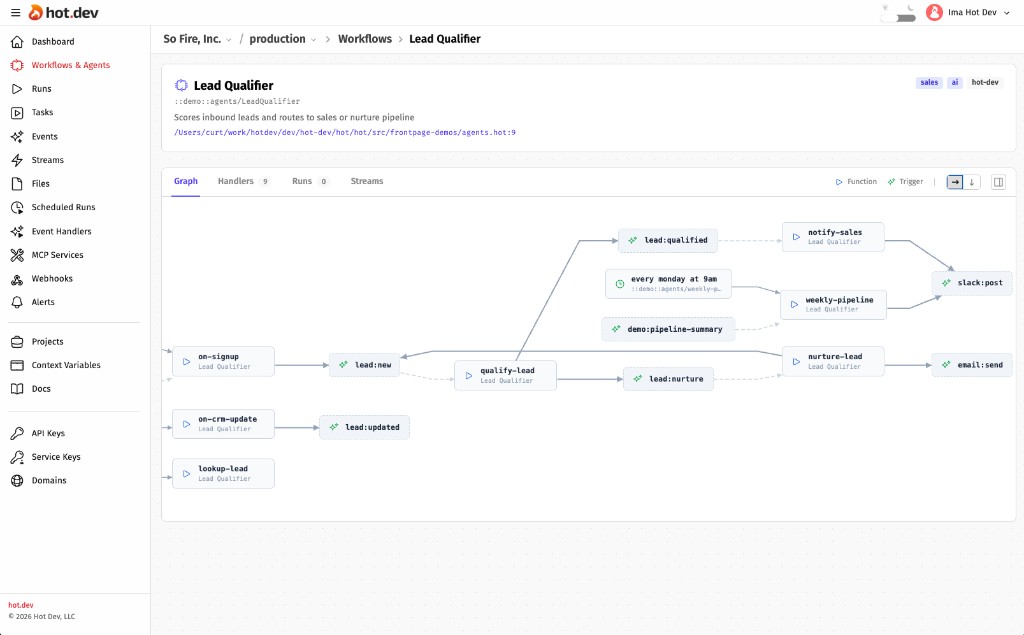
The shape of Hot Dev is no longer a moving target.
What's Open Source
Everything in github.com/hot-dev/hot is Apache 2.0:
- Hot language — compiler, type system, expression evaluator
- Runtime — event handling, scheduling, parallel execution, function-call tracing, task and container execution
- Standard library —
hot-stdand the public packages underhot/pkg - CLI —
hot run,hot dev,hot build,hot deploy,hot test,hot check,hot fmt,hot repl,hot init - Local dev stack — API, dashboard, event worker, scheduler, task worker, and LSP
- Docs and package documentation generation
The hosted Hot Dev Cloud — provisioning, billing, and multi-tenant operations — stays private. Everything you need to build with, run, and self-host Hot Dev is open.
Built in Rust
Hot Dev is a substantial Rust project. The compiler, runtime, CLI, dashboard, API, scheduler, workers, and LSP amount to 200k+ lines of Rust, plus 100k+ lines of Hot in the standard library and packages.
The stack is intentionally small and boring:
- Rust for the language, runtime, CLI, dashboard, API, schedulers, workers, and LSP
- SQLite + in-memory queues for local dev — zero setup
- PostgreSQL + Redis (with cluster support) for production
- OCI containers for Hot Box — any Docker image becomes a callable Hot function
- HTTP, SSE, and WebSocket for streams, tracing, MCP, and tasks
- LSP powers the VS Code / Cursor extension and any LSP client
- Cross-platform — Mac, Linux, Windows
Local dev and production run the same engine, so there's no "works on my machine" gap when you deploy.
Where Hot Dev Cloud Fits In
Hot Dev is the open source project. Hot Dev Cloud is the hosted service, built on top of it.
The open source repo is everything you need to develop, run, and self-host Hot Dev. The cloud is what runs when you'd rather not do ops:
- Managed multi-tenant infrastructure — autoscaling workers, scheduler, tasks, containers, storage
- One-command deploy with TLS, custom domains, and observability
- Operational dashboards — traces, alerts, metrics
- Service Keys and white-label MCP for teams shipping AI tools to their customers
- Hot Box compute billed by the second
- A free tier to get started
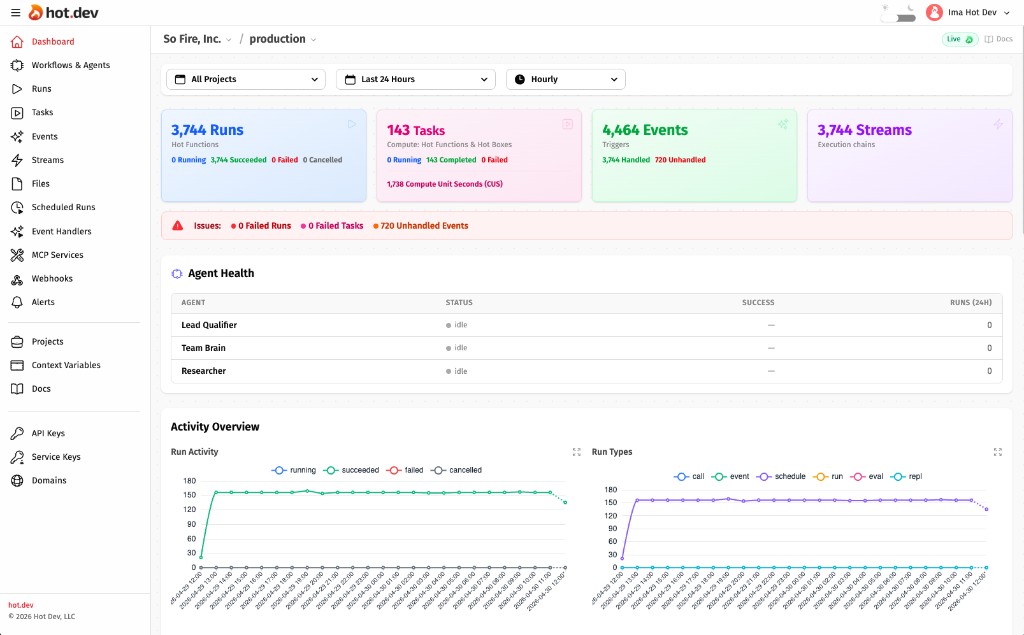
Open source gives Hot Dev a future independent of any one company. The cloud funds the work that goes back into the open source repo.
Self-hosting itself is unrestricted under Apache 2.0 — no separate license, no per-seat fees, the same engine as the cloud. For teams that want a hand getting set up, we offer a paid service covering deployment, configuration, and ongoing support for self-hosting customers. Get in touch to talk through your setup.
Already Using Hot Dev?
Nothing breaks. Cloud accounts, projects, deployments, MCP services, custom domains, webhooks, tasks, and containers keep running on the same infrastructure. The free and paid plans are unchanged.
What changes is what's underneath: you can now read the source, build the CLI from scratch, trace bugs through the runtime, and propose fixes back upstream.
New to Hot Dev?
Getting Started is the fastest path: install, hot init my-app, and the dashboard opens in a few seconds.
How to Get Involved
- Star the repo: github.com/hot-dev/hot
- Try a demo: github.com/hot-dev/hot-demos — runnable projects covering AI agents, MCP, webhooks, and containers
- Report issues: github.com/hot-dev/hot/issues
- Join the conversation: @hotdotdev and Hot Takes
What's Next
Open sourcing the core is the start, not the finish. Coming up:
- More demos and tutorials
- New packages in the standard library
- Deep-dive posts on the Hot Dev codebase
Making Hot Dev open source is how it scales beyond what any one team can build alone.
Get Started
- Source: github.com/hot-dev/hot
- Install: hot.dev/download
- Documentation: hot.dev/docs
- Hot Dev Cloud (free tier): hot.dev/pricing
- License: Apache 2.0
Follow @hotdotdev on X or subscribe to Hot Takes for what's next.